EVIDENCE
The science of the human biofield
Established research in subtle energy, biofield therapies, and consciousness-based healing.
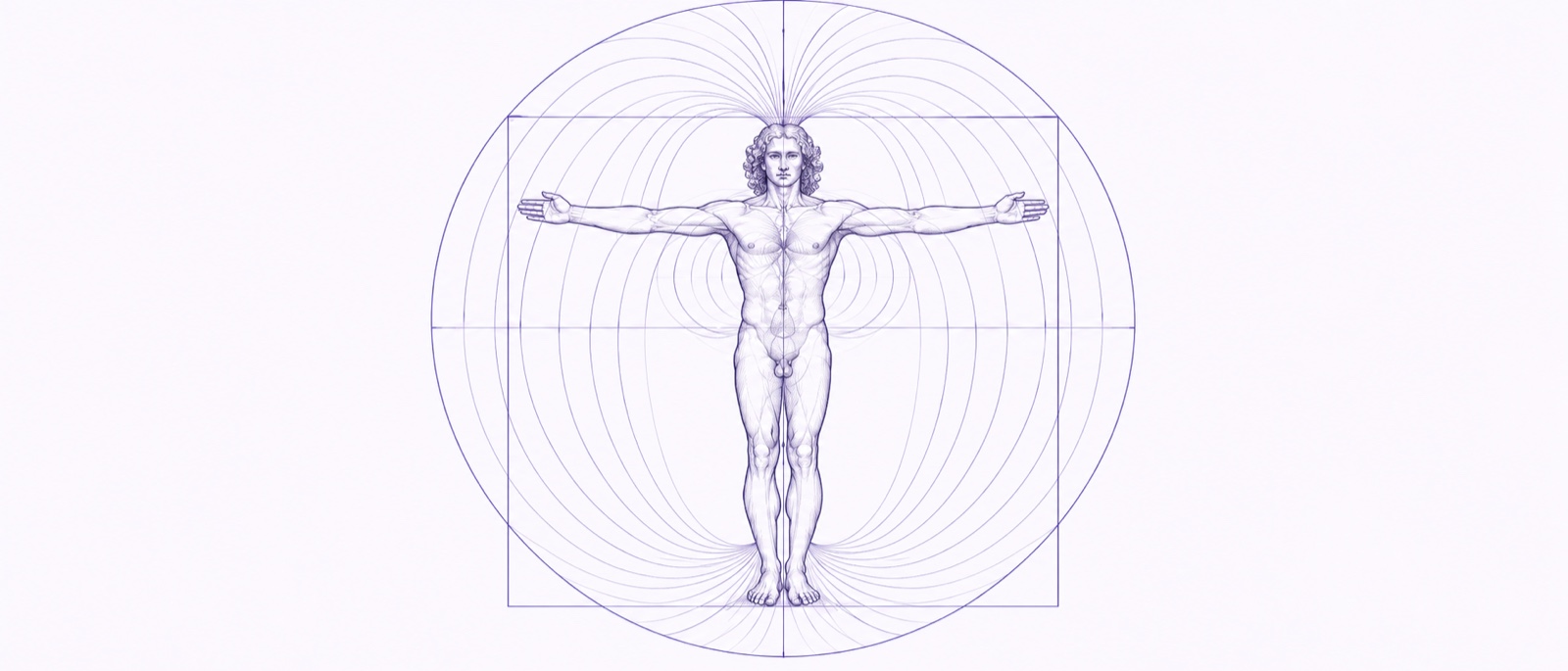
Pore breathing is a practice, not a theory. It asks you to feel something, not to believe something. And the thing it asks you to feel, the field of energy in and around the body, is not only a traditional idea. Parts of it are measured routinely in hospitals. Other parts are open, actively researched scientific questions. A few claims made in this field are not supported at all, and we name those too.
This page sorts all three, honestly. Being clear about what is not proven is how you can trust what is, and what is established is more than most people expect.
ESTABLISHED · HYPOTHESIZED · NOT CLAIMED
ESTABLISHED
The body produces electromagnetic fields that extend beyond the skin
This is not contested and not alternative. Ion currents in the heart and brain generate magnetic fields outside the body, measurable by arrays of superconducting quantum interference device (SQUID) detectors placed near the chest or head. The recordings are called magnetocardiography (MCG) and magnetoencephalography (MEG).
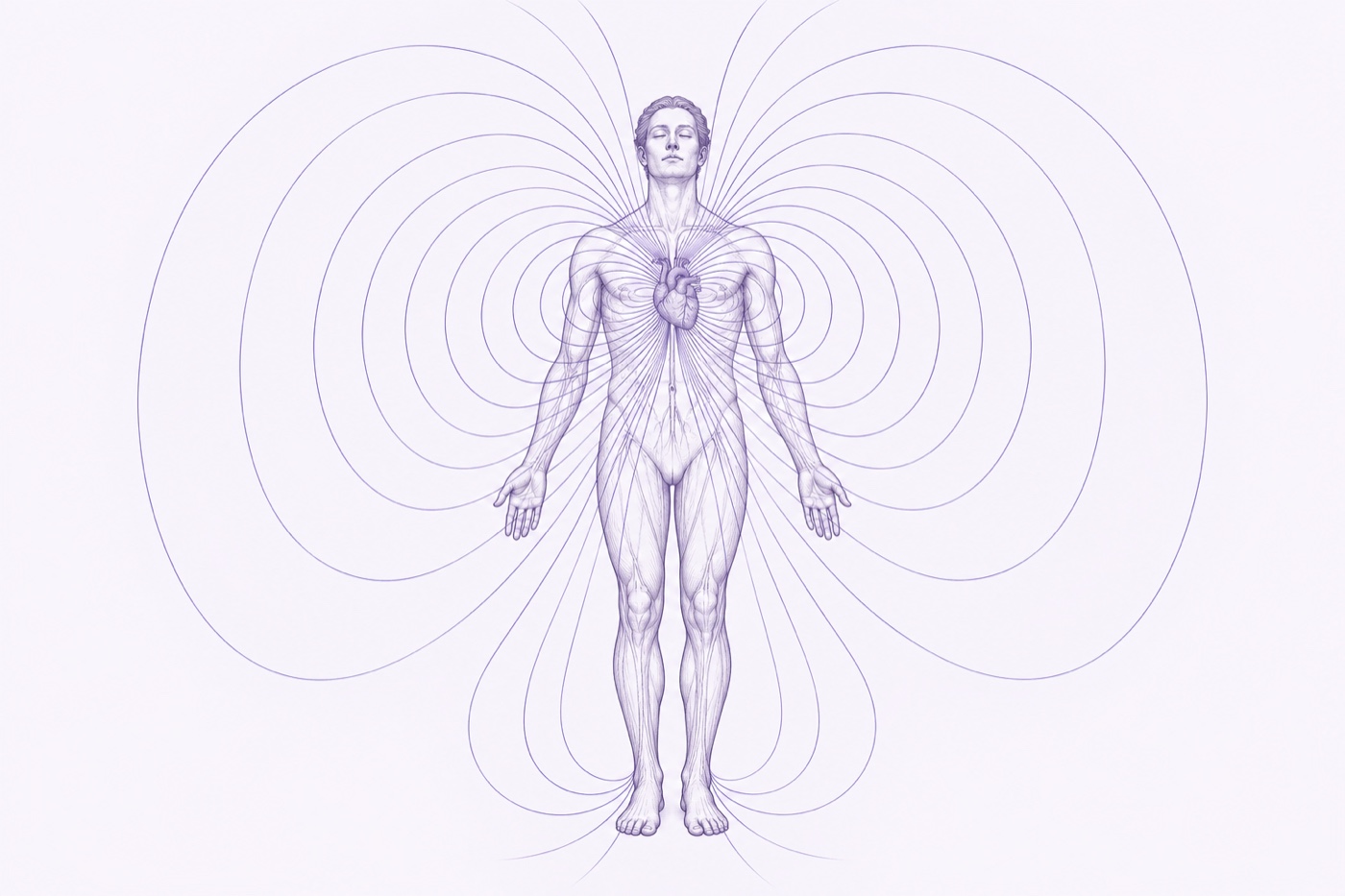
The heart's magnetic field is the largest the body produces and was the first to be measured, biomagnetism as a research field is over sixty years old. These fields pass through tissue essentially unimpeded, which is why MCG is used clinically to detect coronary artery disease and localize regions of ischemia. The signals are extraordinarily faint: the heart's field is on the order of tens of picotesla, the brain's fainter still.
The practical upshot is simple. The human body generates an electromagnetic field that extends past the skin and can be measured with instruments. That is a statement about cardiology equipment, not metaphysics.
ESTABLISHED
The body emits light
The human body continuously emits an extremely faint glow, ultraweak photon emission, roughly a thousand times below the sensitivity of the naked eye. It has been imaged directly using cryogenic CCD cameras, and the emission follows a daily rhythm that appears linked to energy metabolism (Kobayashi, Kikuchi & Okamura, PLoS ONE, 2009).
And here is what it is not. This emission is understood as chemiluminescence produced by reactive oxygen species during lipid, protein, and nucleic acid oxidation, a byproduct of ordinary metabolism. Emission from skin increases under stress such as UV exposure, and the measurement is used in dermatology and cosmetics research to assess oxidative status. It is real light from a real body, with a mundane mechanism. Claims that extend it into evidence for consciousness, intention, or a vital force go well beyond what the measurements support, and some such claims are actively disputed in the current literature.
We include it because it is true, measurable, and genuinely interesting, an example of how much real physics the body is still revealing. We offer it as context, not as proof of anything the practice teaches.
ESTABLISHED
The body senses and responds to vibration
Before anyone speaks of subtle energy, the body is already a vibration-sensing instrument. Every cell converts mechanical force, pressure, stretch, and vibration, into biochemical and electrical signals, a process called mechanotransduction. Its molecular basis was pinned down only recently: the PIEZO1 and PIEZO2 ion channels, proteins in the cell membrane that physically open when the membrane is deformed. Their discovery earned Ardem Patapoutian a share of the 2021 Nobel Prize in Physiology or Medicine. Touch, the sense of body position (proprioception), blood-pressure regulation, and the felt fullness of a deep breath all run through these channels.
The body also runs on electricity. Beyond the familiar nerve impulse, steady bioelectric gradients across tissues help coordinate growth, healing, and form, a line of work extended today by Michael Levin's laboratory at Tufts. Taken together, mechanotransduction and bioelectricity establish something modest but load-bearing: the body is not only chemical. It continuously senses mechanical and vibrational input and signals electrically, which is the physiological ground a breath-and-attention practice actually stands on.
Pore breathing begins from a simple premise, that energy is experienced as vibration, a felt oscillation you can learn to sense and balance. The physiology above does not prove that premise. What it shows is that the body is genuinely equipped to register vibration and signal it, which is all the practice asks of the science: not permission, but plausibility.
WHAT THIS DOES NOT ESTABLISH
This is not evidence that "life force" flows through the pores, and it is not, by itself, the mechanism of pore breathing. What it does dispose of is a common objection, that the body has no way to register subtle mechanical or vibrational change. It demonstrably does, and the receptors have names. Whether the felt "energy" of the practice reduces to these pathways, extends beyond them, or is some of both, is an open question this page does not close.
ESTABLISHED
Health is a balance the body actively maintains
Pore breathing is defined as a practice for sensing and balancing energy. The balancing half of that definition is not a poetic flourish, and it is not unique to esoteric traditions. It is the organizing principle of mainstream physiology.
Homeostasis is the body's continuous work of holding its internal conditions within a viable range, temperature, blood chemistry, pressure, hormonal signaling. Allostasis is the active process by which the body adapts those set points to meet demand. And allostatic load, a model introduced by Bruce McEwen and Eliot Stellar in 1993, describes the cumulative wear and tear on body and brain that accrues when those adaptive systems are called on repeatedly or continuously.
Two details are worth noticing.
The first is what produces the load. It is described in the literature as dysregulation arising from chronic over-activity or inactivity of the physiological systems that normally handle adaptation. The failure mode is bidirectional, too much or too little, not simply too much. Anyone who has worked with the elemental three-state map will recognize the shape of that immediately: overactive, balanced, underactive, with the healthy condition sitting between two ways of failing. The traditions and the physiology describe the same structure in different vocabularies.
The second is that the consequences are not confined to the body. Allostatic load indices are built from neuroendocrine, immune, metabolic, and cardiovascular markers, and elevated load is associated with outcomes that are physiological, psychological, and psychosocial alike. This is the empirical version of a claim the traditional systems have always made: strain the balance and the whole person feels it, in body, feeling, and mind.
WHAT THIS DOES NOT ESTABLISH
The allostatic load literature is explicit that the model cannot explain all causes of ill health and disease, and neither do we claim it. Genetic conditions, infection, and injury do not arise from imbalance. Nor does any of this demonstrate that the elemental framework maps onto measured physiology, that is a structural resemblance, not a proven correspondence. What it does establish is that "health is a balance you maintain, not a state you arrive at" is a mainstream physiological position, not a wellness slogan.
One further note: allostatic load appears to be responsive to intervention, a scoping review using it as an outcome measure found reductions across several studies. That makes balance a modifiable quantity rather than a fixed one, which is precisely what a balancing practice sets out to work with.
FORMALIZED
Where the word "biofield" comes from
The term was not coined by the wellness industry. It was proposed in 1992 by an ad hoc committee of researchers and practitioners convened by the newly established Office of Alternative Medicine at the US National Institutes of Health, at a conference in Chantilly, Virginia. The committee's goal was to find one term for a scattered group of practices (Reiki, therapeutic touch, external qigong and others) that would be usable by the scientific and healthcare communities.
The term was subsequently accepted as a Medical Subject Heading at the US National Library of Medicine, making it an indexed search term in the peer-reviewed literature, and NIH's successor center funded a round of research grants in biofield science. The panel was chaired by Beverly Rubik, who holds a doctorate in biophysics from UC Berkeley.
The committee's original definition is worth quoting precisely, because its hedging is honest: a massless field, not necessarily electromagnetic, that surrounds and permeates living bodies and affects the body. Note the phrase not necessarily electromagnetic. That is a hypothesis being framed, not a finding being reported.
HYPOTHESIZED
What biofield science proposes
Biofield science treats the organism's very weak electromagnetic field as potentially carrying regulatory information, a candidate mechanism for how a body coordinates itself as a whole rather than as a collection of parts. The main references are Rubik's "The Biofield Hypothesis: Its Biophysical Basis and Role in Medicine" (Journal of Alternative and Complementary Medicine, 2002) and the 2015 special issue of Global Advances in Health and Medicine on biofield science and healing.
Adjacent work makes the general picture more plausible. Robert O. Becker's research on bioelectricity and regeneration, including the finding that acupuncture points show increased DC electrical conductivity, is foundational and is cited within the biofield literature itself; his direction has since been substantially extended by Michael Levin's bioelectricity work at Tufts. And in photomedicine, Michael Hamblin's research at Harvard's Wellman Center identifies cytochrome c oxidase in the mitochondria as the primary absorber of red and near-infrared light, with near-infrared also absorbed via structured water in heat-gated ion channels, a demonstrated pathway by which energy arriving at the skin changes cellular function.
IN PRACTICE
Biofield approaches are moving into mainstream care
The biofield is not a fringe concern. Biofield-based therapies are increasingly offered inside conventional medicine. In a 2015 survey, 30% of US Veterans Affairs medical systems offered some form of energy medicine to veterans, up from 7% in 2011, and Reiki, Therapeutic Touch, and Healing Touch are used in hospitals around surgery and cancer care (US Department of Veterans Affairs, Passport to Whole Health, ch. 17).
The evidence base for those therapies is growing. A 2025 peer-reviewed scoping review catalogued 353 biofield-therapy studies and found that nearly half (172) reported positive results, with pain and cancer among the most-studied conditions (Sprengel et al., Journal of Integrative and Complementary Medicine, 2025). A 2016 systematic review of 27 trials (3,159 participants) found significant benefits across mood, fatigue, quality of life, and pain, and the Natural Medicines database rates Therapeutic Touch as “possibly effective” for anxiety, pain, and stress.
The research is still early, and reviewers rightly call for higher-quality trials. But the direction is encouraging, and the funding gap reflects how long this work sat outside the dominant biomedical paradigm, not a verdict against it. Pore breathing is a self-directed practice rather than a practitioner-delivered therapy, but it belongs to the same family of work, and that family now has a dedicated research community, including the NIH-lineage Consciousness and Healing Initiative and the twelve-paper Biofield Science and Healing collection in Global Advances in Health and Medicine.
STUDIED
Related practices
Pore breathing itself has not been studied in a clinical trial. Four practices adjacent to it have, and each is worth looking at directly.
Breathwork (slow breathing), well supported and directly applicable
Pore breathing is performed at a slow, nasal, diaphragmatic cadence, the calm, well-evidenced end of breathwork rather than the intense hyperventilation styles, which places it squarely inside a large and consistent literature. Meta-analysis of voluntary slow breathing finds increases in vagally-mediated heart rate variability during practice, after a single session, and after a multi-session program. Slow breathing shifts autonomic balance toward parasympathetic activity and increases baroreflex sensitivity. The standard reference is Zaccaro et al., Frontiers in Human Neuroscience, 2018.
This applies to pore breathing mechanically rather than by analogy, the cadence is the cadence. It is also worth being clear about what it explains: the calming, settling, and stress-regulating effects reported by practitioners have a well-established autonomic explanation that does not require any energetic model at all. We regard that as good news, not a threat. A practice does not need every one of its effects to be mysterious.
Meditation, the practice pore breathing belongs to
Pore breathing is a meditation, and meditation is among the most-studied contemplative practices. A landmark meta-analysis of 47 trials with more than 3,500 participants found moderate-quality evidence that meditation programs improve anxiety, depression, and pain (Goyal et al., JAMA Internal Medicine, 2014), and focused-attention training shows measurable effects on sustained attention and emotional regulation.
This applies to pore breathing directly rather than by analogy: it trains sustained attention resting on a single felt object, the exact skill these studies examine. So the calm and mental clarity practitioners report have a well-supported basis that requires no energetic model at all. What the meditation literature does not test is the one thing that makes pore breathing distinct, whether the object of attention, energy itself, is what the practice takes it to be.
Qigong, the nearest studied relative
Qigong is the closest thing to pore breathing with a substantial research base: an energy-cultivation tradition, studied for decades. A meta-analysis of 19 randomized trials of Baduanjin qigong reported benefits for quality of life, sleep quality, balance, handgrip strength, trunk flexibility, blood pressure, and resting heart rate, and further reviews cover sleep in older adults, quality of life in cancer patients, and chronic low back pain.
The evidence quality is the weak point, and we would rather state it than let someone else discover it. An overview of thirteen systematic reviews of qigong for chronic obstructive pulmonary disease found that every review carried at least one critical methodological flaw, none reported fully to PRISMA standards, and only three outcomes across all of them reached high quality under GRADE. A 2025 umbrella review rated qigong for depression and quality of life as supported by weak evidence. Most trials are conducted in a single research culture, which raises the ordinary questions about publication bias.
One honest limitation. A trial of qigong shows that people who practice qigong experience outcomes. What it cannot do is separate "energy cultivation works" from "gentle movement, slow breathing, and sustained attention work", no trial of that design can. So it supports the family of practices pore breathing belongs to, and leaves the question of mechanism genuinely open. We offer it in that spirit: encouraging, not conclusive.
Acupuncture, the qi tradition with the strongest evidence
Acupuncture is the most rigorously tested practice built explicitly on the concept of qi. An individual-patient-data meta-analysis pooling 39 trials and nearly 21,000 patients found acupuncture more effective than both sham needling and no acupuncture for chronic pain, including back and neck pain, osteoarthritis, and chronic headache, with effects that persisted over time (Vickers et al., The Journal of Pain, 2018).
Traditionally this is explained as regulating the flow of qi through meridians. Modern mechanistic work offers other handles: needling triggers local connective-tissue and fascial responses, releases adenosine at the site (Goldman et al., 2010), and engages endorphin and nervous-system pathways, while acupuncture points themselves show measurably higher DC electrical conductivity (Becker). The parallel to pore breathing is direct: acupuncture works this same life force from the outside, with needles at fixed points, whereas pore breathing works it from the inside, with breath and attention, no needles and no practitioner.
One honest limitation. Sham acupuncture often performs surprisingly well, and effect sizes are moderate, so the evidence establishes that acupuncture helps more firmly than it settles why. As with qigong, it supports the family of practices pore breathing belongs to and leaves the mechanism an open question.
NOT CLAIMED
What this practice does not claim
The biofield is an open question, not a settled fact. That the body produces measurable fields is established; that those fields carry regulatory information, or correspond to what tradition calls qi or prana, is a hypothesis under active investigation. We do not claim it is proven, and pore breathing itself has not been studied in a trial.
We make no medical claims. Pore breathing is a wellness practice, not a treatment; it does not diagnose, treat, cure, or prevent disease. Read the practice safety notice →
What we do stand behind is simpler, and testable: that you can feel something, and learn to sense and balance it. That part you can verify yourself, which is the only verification the practice has ever asked for.
Science explains the how. Your body reveals the what.
Every claim on this page could be revised tomorrow and your practice would be unaffected, because pore breathing is not taught from theory. It is taught from feedback: you place your hands, rest attention in the space between them, and notice whether the felt quality changes when the distance changes. If it does, you are perceiving something. If it does not, no amount of research would make it so.
The science on this page is a map offered to someone who already knows how to walk, context, not permission.
References
McEwen, B. S. & Stellar, E. "Stress and the Individual: Mechanisms Leading to Disease." Arch Intern Med 153(18):2093–2101, 1993. · Juster, R.-P., McEwen, B. S., & Lupien, S. J. "Allostatic Load Biomarkers of Chronic Stress and Impact on Health and Cognition." Neurosci Biobehav Rev 35(1):2–16, 2010. · Zaccaro, A., et al. "How Breath-Control Can Change Your Life: A Systematic Review on Psycho-Physiological Correlates of Slow Breathing." Front Hum Neurosci 12:353, 2018. · Zou, L., et al. "A Systematic Review and Meta-Analysis of Baduanjin Qigong for Health Benefits: Randomized Controlled Trials." Evid Based Complement Alternat Med, 2017. · Shi, H., et al. "Scientific Evidence of Traditional Chinese Exercise (Qigong) for Chronic Obstructive Pulmonary Disease: An Overview of Systematic Reviews and Meta-Analyses." 2022. · Roth, B. J. "Biomagnetism: The First Sixty Years." Sensors 23(9):4218, 2023. · Kobayashi, M., Kikuchi, D., & Okamura, H. "Imaging of Ultraweak Spontaneous Photon Emission from Human Body Displaying Diurnal Rhythm." PLoS ONE 4(7):e6256, 2009. · Tsuchida, K., Iwasa, T., & Kobayashi, M. "Imaging of ultraweak photon emission for evaluating the oxidative stress of human skin." J Photochem Photobiol B 198:111562, 2019. · Rubik, B. "The Biofield Hypothesis: Its Biophysical Basis and Role in Medicine." J Altern Complement Med 8(6):703–717, 2002. · Rubik, B., Muehsam, D., Hammerschlag, R., & Jain, S. "Biofield Science and Healing: History, Terminology, and Concepts." Glob Adv Health Med 4(suppl):8–14, 2015. · Hamblin, M. R. "Mechanisms and Mitochondrial Redox Signaling in Photobiomodulation." Photochem Photobiol 94(2):199–212, 2018. · Becker, R. O. & Selden, G. The Body Electric: Electromagnetism and the Foundation of Life. William Morrow, 1985. · Goyal, M., et al. "Meditation Programs for Psychological Stress and Well-being: A Systematic Review and Meta-analysis." JAMA Intern Med 174(3):357–368, 2014. · US Department of Veterans Affairs. Passport to Whole Health, Chapter 17: Energy Medicine, Biofield Therapies, 2019. · Sprengel, M. L., et al. "Biofield Therapies Clinical Research Landscape: A Scoping Review and Interactive Evidence Map." J Integr Complement Med 31(5):406–430, 2025. · Hammerschlag, R., et al. "Biofield Physiology: A Framework for an Emerging Discipline." Glob Adv Health Med 4(suppl):35–41, 2015. · The Nobel Assembly at Karolinska Institutet. "The 2021 Nobel Prize in Physiology or Medicine" (D. Julius & A. Patapoutian), 2021. · Coste, B., et al. "Piezo1 and Piezo2 Are Essential Components of Distinct Mechanically Activated Cation Channels." Science 330(6000):55–60, 2010. · Vickers, A. J., et al. "Acupuncture for Chronic Pain: Update of an Individual Patient Data Meta-Analysis." J Pain 19(5):455–474, 2018. · Goldman, N., et al. "Adenosine A1 Receptors Mediate Local Anti-nociceptive Effects of Acupuncture." Nat Neurosci 13(7):883–888, 2010.
COMMON QUESTIONS
Questions about the evidence
Is the human biofield scientifically proven?
Partly. That the body produces electromagnetic fields extending beyond the skin is established and measured clinically. That this field carries regulatory information, or corresponds to what traditional systems call qi or prana, is a hypothesis under investigation.
Has pore breathing been studied scientifically?
No. Related practices have been: slow breathing has strong evidence for autonomic and heart-rate-variability effects, and qigong has a substantial but methodologically weaker literature. Neither examined pore breathing, and neither tests whether the energetic explanation is correct.
Is "balance" just a metaphor?
No. Homeostasis and allostatic load are mainstream physiological concepts describing health as an actively maintained balance whose failure mode runs in both directions, too much activity or too little. The elemental three-state map describes the same shape in an older vocabulary. That is a structural resemblance, not a demonstrated correspondence.
Do I need to believe in any of this to practice?
No. The practice is built on sensation. If something is real you will feel it, and if it is not, belief will not make it so. Try it now →